Friday, 11 May 2012

An Action (OK-YUH-PAHY)


An Action
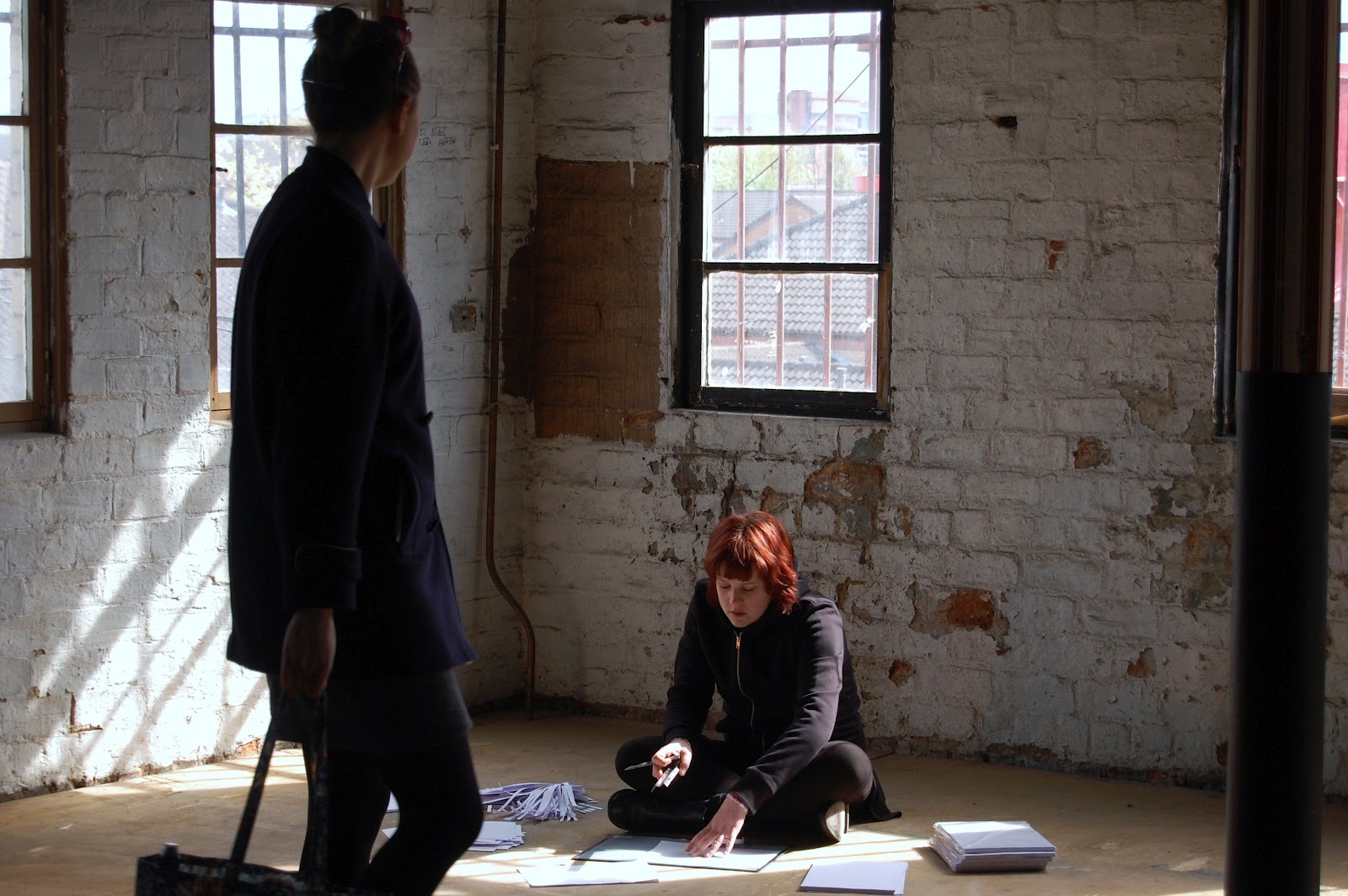
An act repeated. Slicing, slicing, slicing. An endurance. The product of the action surrounds the artist, showing the duration of the act. The act is not forced nor a trial. It is a labour in which the artist is content, purposeful. The repetition does take its toll however, it is minutely physical. Cramp, pins and needles, numbness rising from the floor, aches where the same muscles are told to do the same action incessantly. Compelling or mesmerising the audience can wonder at why and what for, does it matter?


This was a performance for Ok-YUH-PAHY, a show at the Pipe Factory in Glasgow as part of Glasgow International Festival of Visual Art. The performance lasted from 11am-7pm (with 2 half hour breaks, give or take). I was cutting A4 sheets of paper into 20x20cm squares.


I find that performances aren't easily tested as they need an audience. This one worked out better than I anticipated, despite having only been thought through in my head. The audience seemed to understand what I was doing easily and accepted that I was repeating the action all day.


When I have performed before I have often been unpicking canvas and dipping the resulting threads into oil medium. The audience have watched for a time, mostly to work out what the materials are, and then maybe what I am doing and why. The aim of this work was to cut out the painting materials and the associated connotations and just concentrate on a simple, repeated action. This was a little too successful though, as I think the audience understood too quickly what I was doing and moved on, there was little lingering or prolonged engagement.


Another surprise was how intriguing I found the paper itself, and actually how meditative the action was. I was worried the line 'It is a labour in which the artist is content, purposeful.' would turn out to be a lie and it would be a laborious, boring and insufferable day. It wasn't though, partly owing to the paper itself. Essentially it was the cheapest, white A4 paper I could get hold of. It was very thin and almost purple in colour and around 3 sheets out of 5 had a mark on them. These marks looked like they had been made in the factory in the process of making the paper, like they were clumps of fibres which had stuck together and hadn't been bleached properly. Owing to the cheapness of the paper it was really thin, you could see through it slightly and see its pattern. 


As the day went on, the blade on my knife became more and more blunt, so the paper squares every now and then were nicked slightly as the knife got caught. It is these things, which are unseen and unknown by the audience which makes the performance work for me. I need to work on a performance which is more compelling for a viewer, and which possibly has this element of uncovering the behaviour of a material.


Thursday, 27 October 2011

EX

As has become a habit this post is late late late. I have been working full time though so thats my excuse!

Canvas Unpicked and Dipped III, 2011, Canvas, Stretcher, Lukas IV Medium

I was in a show called EX at Leeds College of Art in September/October. There were around 10 artists, all of whom completed their foundation course at Leeds College of Art. The selectors selected eligible students based on their degree shows. This meant most (if not all) of us showed work which was in our degree shows. 

There was some really exciting work. Ash Harris and Emily Illet showed a video of a performance. The artists were on separate screens in profile, facing each other. Both had their eyes closed and were moving as if bowing to each other, leaning forward and back. The seemed to be sensing each others' movements and responding, very compelling. Romany Dear showed a work in which the audience were the performers. She asked us, for 8 minutes, to embrace absolutely everything. You took a tape player off the wall, put headphones in, pressed play, and followed instructions. Though it wasn't like following instructions. The voice was whispering in your ear, egging you on, making you laugh and encouraging to explore the exhibition, the work, the space, the rules and expected behaviour.

As I had already re-shown my degree show pieces at Seventy Feet (see previous post) I was pretty bored of the work I was showing. However the space I had to show in was such an unusual spot it allowed me to have some fun placing it and let a little of my boredom and frustration come across in the installation.


The work ended up awkwardly shoved into the bars of the stair case, it was leaning against the radiator and hovering just off the pillar. The extra canvas is hung over the bannister and the medium dipped lattice is crumbling, dripping and giving up, falling off the frame and onto the pillar and floor.


Saturday, 30 July 2011

Seventy Feet

Long overdue post!
Seventy Feet was an exhibition at the Free Range Graduate Art Show in the beginning of July by 35 Fine Art graduates, recently of Bath School of Art and Design. We have been raising money to fund the exhibition all year and all the effort paid off in the end. 


We had a huge space. The curators, Charlotte Bartrop, Emily Cooper and Louise Grant did a brilliant job at making sure 35 mostly unrelated practices hung together coherently. Below are images of a few of my favourite pieces/best images from the exhibition.


Nick Stamp


Beryl Desmond (www.beryldesmond.blogspot.com)


Anna Borowicz (www.annaborowicz.blogspot.com)


Vicki Ley (www.victorialey.wordpress.com)


Jenny Cooper (www.jenny-cooper.co.uk)

I showed the same works as I did for degree show, so won't re-post images (especially as I was spoilt with the amazing light at degree show and the warehouse was a tad dark.) However I did play around with Unpicked and Dipped IV a little more, bringing it completely away from the wall. It seemed very exposed as it is quite a small piece, but really benefited from having more room to breathe.


A live art programme ran throughout the week, with performances and live drawings happening alongside the more static works. I performed 'Unpicking and Dipping'. I've been struggling this year with performances, I think the problem was trying to fit too much into them which became confusing for an audience. This performance was concentrating on the action of unpicking canvas and dipping it into oil medium. It was very simple and seemed to work well.


An exciting part of the show was seeing all the other shows on at the same time. I met two performance artists who had been studying Fine Art at Bournemouth; Claire Prosser and Rebecca Helen Page. I watched Rebecca perform 'Fragile', she began the performance tied to a pillar with the kind of tape put on fragile parcels, white with FRAGILE written in red. The performance was Rebecca trying to free herself from the tape. The work had an otherworldly quality as the artist seemed naive and alien. She broke loose with an air of curiosity rather than desperation; she was quite happy tied to the pillar, but was just seeing if she could free herself (www.rhpage.tumblr.com). I didn't see Claire's work, but her website is worth a look (www.claireprosser.co.uk) 

Monday, 20 June 2011

Degree Show!


Degree Show is over as of last Thursday!
My plan for the show was to have a few pieces of work (two painting/installations and 8 photographs) available and to play with them in the space until they settled and began to look like a show. In the end I showed both painting/installations and one of the images.
Canvas Unpicked and Dipped III is shown above, I saw this as my main work. The other two pieces, pictured below, were Canvas Unpicked and Dipped IV and a digital photograph entitled Medium Behaviour (2).


All the works shown explore the materials of painting, and in particular canvas, through a process of unpicking and soaking canvas threads in oil medium. There is also a play with the relationship between the canvas and the frame. Both painting/installation works began with the canvas stretched over the frame, as if I was going to paint on it. The canvas has then been pulled off, unpicked and the threads soaked before being laid back over the frame. The canvas was then pulled off the stretcher for a second time and, in the case of Canvas Unpicked and Dipped III, is shown hugging the frame again. 


Apart from a fairly continuous level of panic the whole way through I enjoyed installing the works in the show. It wasn't dissimilar to making the works, in that it involved a level of playing and testing until the pieces seemed to make themselves. Canvas Unpicked and Dipped III in particular suddenly settled into position. Canvas Unpicked and Dipped IV was exciting to install as it seemed personified. The canvas lattice ended up on its back, showing its soft underbelly and as such was quite vulnerable.  

The works will be installed in Seventy Feet, as part of the Free Range Graduate Art Show from the 7th to the 11th July. F block T3, Free Range Graduate Art Show, Old Truman Brewery, Brick Lane, London E1 6QL  

Saturday, 7 May 2011

Canvas Details


These are a collection of images I have been taking throughout the making of my unpicking canvas works. They all show details of canvas, displaying its materiality and behaviour.


Saturday, 30 April 2011

Friday, 22 April 2011

Canvas Unpicked and Dipped III

 
These are a series of images showing the making of the work I am intending to show at degree show. (Bath School of Art and Design Degree Show, 11th - 15th June 2011) I have built a 120 x 200cm stretcher and stretched it with canvas. The canvas has been tugged off the stretcher and is being unpicked thread by thread.


 As each thread is unpicked it is dipped in oil medium before being laid back over the stretcher. Each strand is laid over the stretcher in the same direction as it was unpicked from, i.e. if a thread was pulled from the canvas vertically it is lain vertically. The 'finished' lattice of dipped threads then will, in part, be a description of the structure of the canvas. The oil medium is vital in retaining the liquid, visceral quality of painting. The addition of the medium and the process of redeploying the canvas strands means the work is not only read as a deconstruction of painting.


The finished installation will hold the performance of the making within it but also transcend the process. The viewer will be asked to look at the, often hidden, materials of painting and see them in a different light.